
Some people ask whether identity verification on Claude is restricted in Korea, or even blocked because of a new Korean policy. After checking official sources, that claim is not accurate. What is closer to the record is that photographing a Korean ID and running a generic government-ID check often cannot proceed under the verification vendor’s default rules. What a Korean user actually sees still has to be separated from privacy disclosures and product help: it is not safe to say Claude has fully switched to a local path, or that verification in Korea is impossible. The details below were checked on 19 November 2026 (Singapore time).
The limit is the resident registration number, and it is not a new 2026 rule
Article 24-2 of Korea’s Personal Information Protection Act (PIPA) generally prohibits processing resident registration numbers, except in limited cases such as when a statute specifically requires or permits it. That restriction has been in force since 7 August 2014. It is not a policy that first appeared in 2026, and user consent alone is not enough to collect the number.
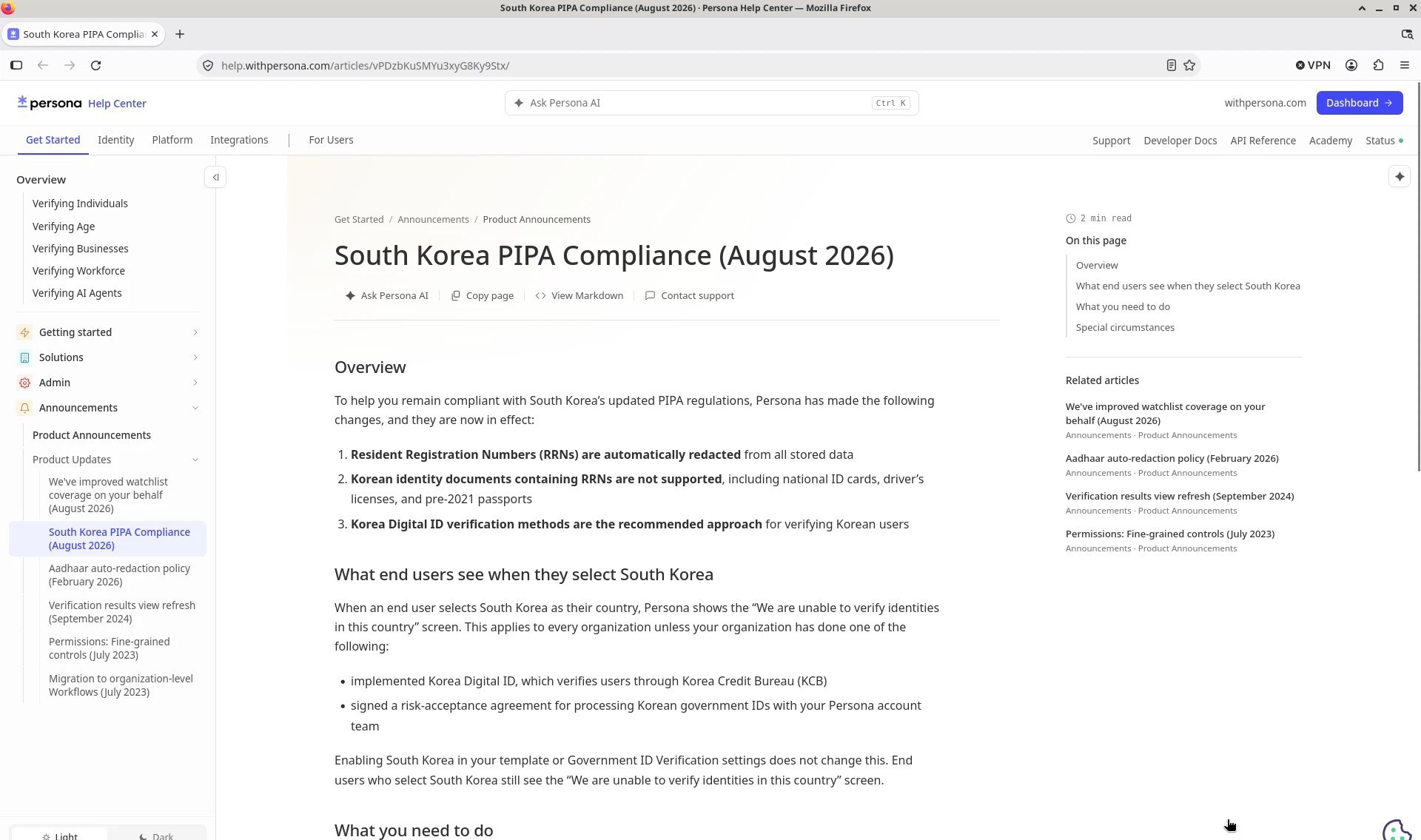
Claude’s verification partner is Persona. In its August 2026 PIPA compliance note, Persona says resident registration numbers are automatically redacted from stored data; Korean identity documents that contain those numbers—including national ID cards, driver’s licenses, and pre-2021 passports—are not supported; and if a user selects South Korea, the user sees “We are unable to verify identities in this country,” unless the organization has implemented Korea Digital ID or signed a risk-acceptance agreement for processing Korean government IDs. So a rejection after trying the ordinary photo-ID path in Korea is a real outcome under those default rules. That does not mean Claude has abandoned verification in Korea.
A KCB disclosure is not the same as every account having that flow
Anthropic’s current Privacy Policy is dated 10 September 2026. The Korea addendum says that, for identity verification and fraud and abuse monitoring, Anthropic collects name, birthdate, sex, native-foreigner-code, and DI (duplication information), and retains that data until account deletion. Processing is delegated to Korea Credit Bureau (KCB). The same data is transferred to Persona in the United States and retained for three years.
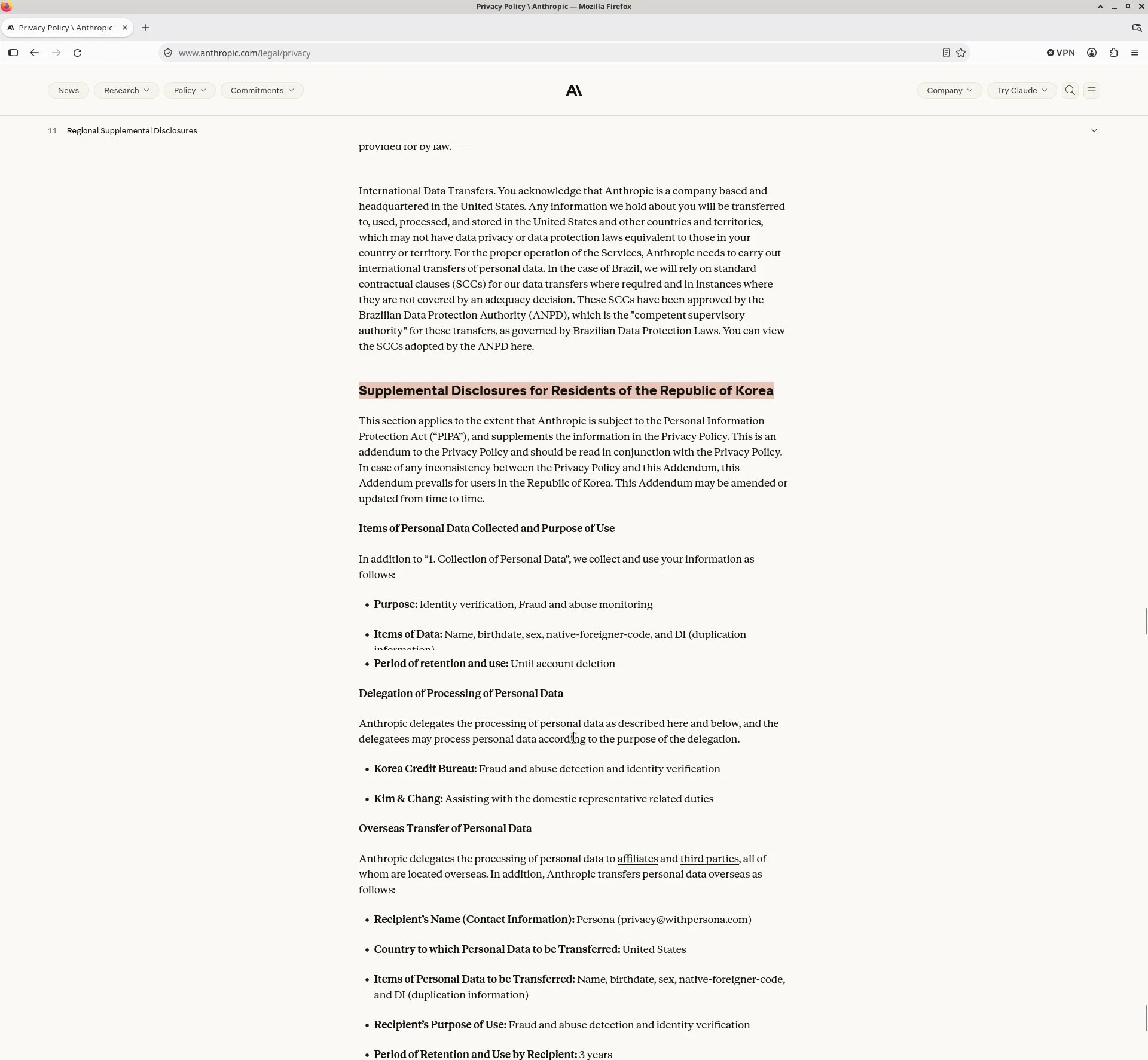
This is a privacy disclosure. It does not mean every Claude account will be shown a KCB prompt, and it does not mean a phone number is enough to pass. Anthropic’s identity verification help article, updated 11 August 2026, still mainly describes a government photo ID and a selfie, and it does not separately document a Korea-specific KCB flow.
Phone verification here is not an SMS code
Persona’s Korea Digital ID documentation, updated 30 September 2026, says the user confirms their identity with KCB in a KCB window. The available methods are a mobile phone plan registered in the user’s name, including the PASS app; a credit card issued in the user’s name; or an i-PIN. This flow does not ask the end user for a resident registration number or a photo of a Korean government ID. The organization configures which methods appear; the user does not pick them on a Persona screen, and i-PIN may not be available for every organization. Even if Claude has enabled one of these methods, that is not the same as “a phone number is enough to pass.”
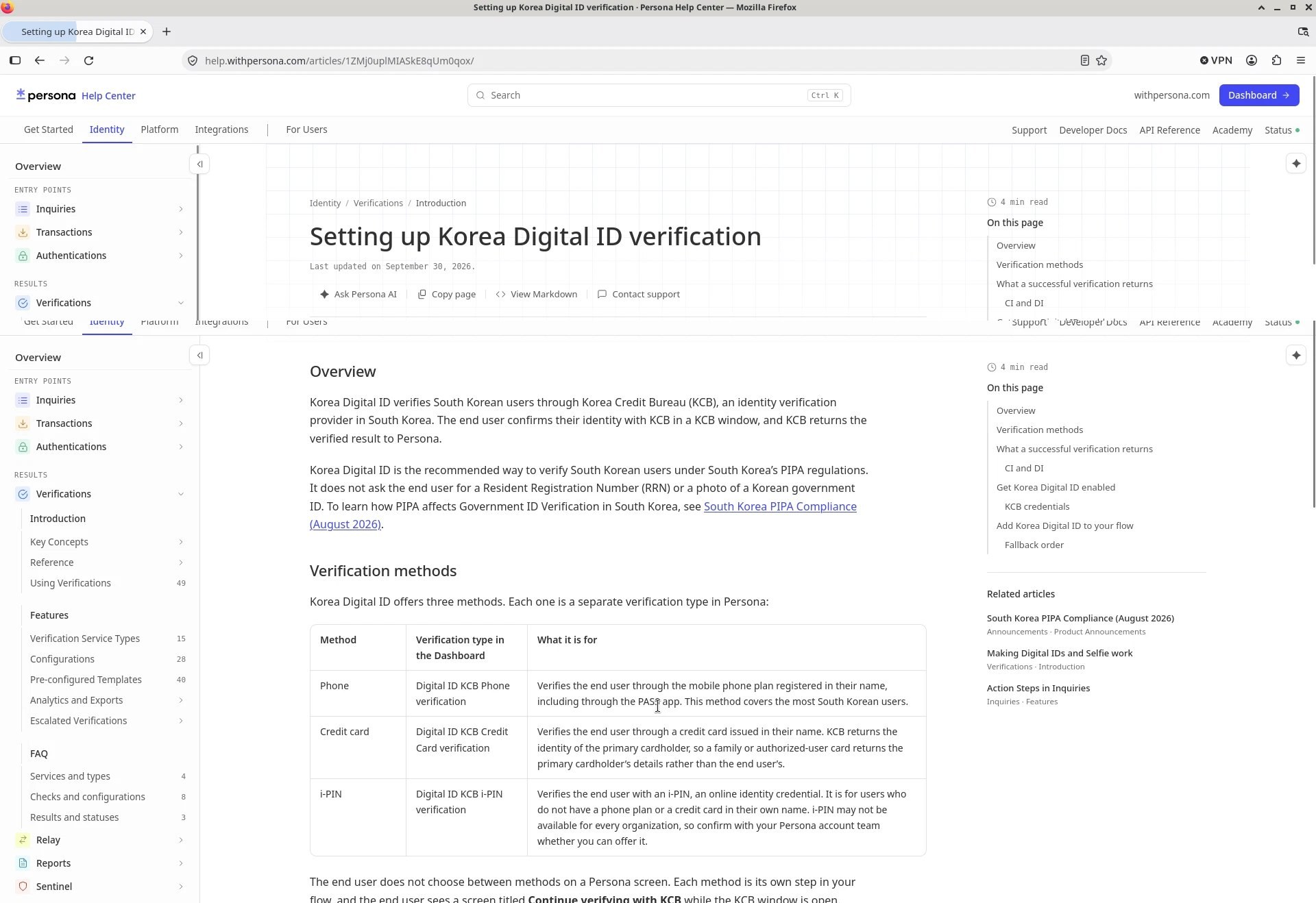
The phone method checks the identity registered to that plan with a Korean carrier. That is not the same as being able to receive a text message. Google Voice, SMS-receiving platforms, and online virtual numbers usually have no real-name record with a Korean carrier, so they are unlikely to complete this check. A Korean MVNO plan (알뜰폰) is also generally opened under a real name, but that does not guarantee it will pass Claude verification. What matters is which method is actually enabled and how the check turns out.
The SMS code at sign-up is a separate step. Claude’s phone verification help article still requires new users to receive a six-digit code on a number from a supported location, and it says VoIP numbers, Google Voice, numbers created using apps, and landlines are not accepted. That only shows you can receive a text at that number. It is not identity verification.
Checked on 19 November 2026 (Singapore time). This article is based on public statutes, the privacy policy, and help documentation. We did not sign in or complete a Korean verification flow. Official pages may change; rely on the page in effect at the time.
For Claude-related products on this site, plan options and descriptions are those shown on the product page.