Claude (developed by Anthropic) is one of the most popular AI assistants today. Its pricing system is divided into Individual/Membership plans、Team/Enterprise plans and API (Developer) plans three major categories. the official pricing page (click to go directly) updates model versions and details over time; this article is based on the latest information as of late February 2026.
Overall comparison (one-sentence summary)
|
Dimension
|
Individual (Free/Pro/Max)
|
Team
|
Enterprise
|
API
|
|
Target users
|
Individuals, students, freelancers
|
Small/medium teams of 5+
|
Large organizations / compliance needs
|
Developers, products, automation
|
|
Payment method
|
Fixed monthly fee
|
Per seat/month (minimum 5)
|
Custom quote
|
By token usage
|
|
Usage limits
|
Message count / time caps (Max highest)
|
Higher org-level limits
|
Highest / customizable
|
No cap (just pay)
|
|
Collaboration
|
Individual or limited sharing
|
Project sharing, collaboration
|
Advanced permissions, auditing
|
None (API calls)
|
|
Security & compliance
|
Basic
|
Medium (SSO, admin)
|
Highest (HIPAA, audit, SCIM)
|
Depends on your implementation
|
|
Model access
|
Sonnet primarily + some Opus
|
Full + priority
|
Full + highest priority
|
Any model, unlimited calls
|
|
Best use cases
|
Daily writing, learning, light development
|
Team knowledge management, collaborative development
|
Enterprise-grade deployment, sensitive data
|
Building AI products, batch processing
|
1. Individual / Membership Plans
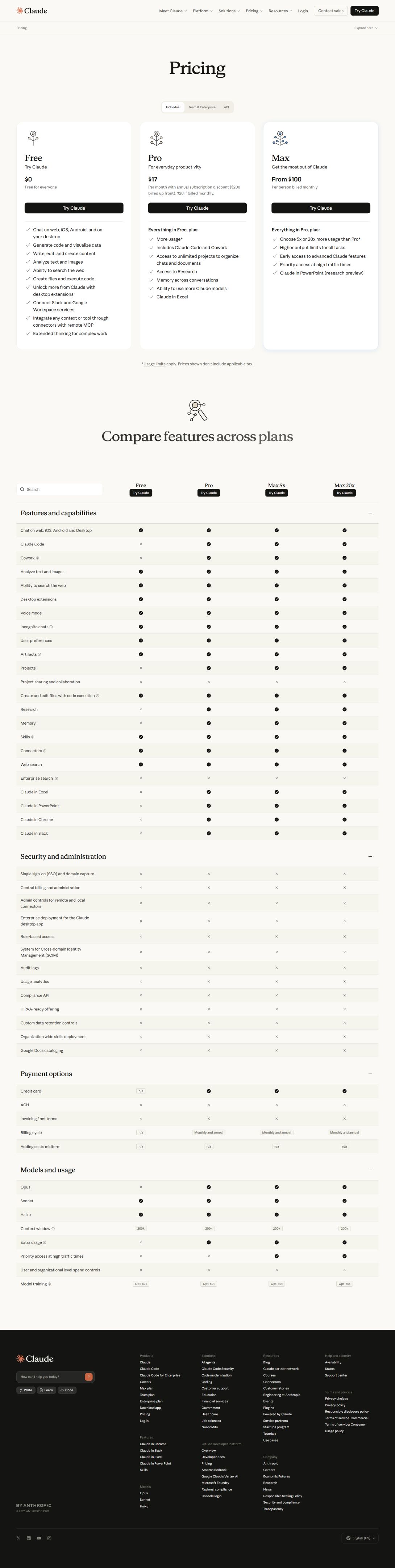
For general users, students, freelancers and heavy daily users. It is divided into several tiers: Free, Pro and Max.
Free → try it out; Pro → the best value for most people; Max → for professional/heavy users to unlock higher throughput and priority.
- FreePrice:$0,Suitable for: light experience and trials,Main features:
- Web, iOS, Android and desktop chat
- Basic model access (usually mainly the Sonnet series)
- Web search, text/image analysis, Artifacts, Projects and other basic capabilities
- Context window of about 200K tokens
Limits: strict caps on message count per 5 hours, possible slowdowns during peak times, and no priority access.
- Pro Price:$20/month(monthly) or about $17/month($200 prepaid annually, equivalent to a discount),Suitable for: daily productivity users and individuals who need stable, high-frequency use,Upgrade highlights (vs. Free):
- Usage is roughly Free's 5x
- Includes Claude Code (code generation/explanation/execution environment)
- Cowork (collaborative chat), unlimited Projects, Research mode, Memory that persists across sessions
- Desktop extensions, Google Workspace connector, Slack integration
- Priority access during peak times, higher output limits
- Access to the latest models (such as Sonnet 4.6 and some Opus)
- Max(advanced individual plan)Price:$100/month(5x tier) or $200/month(20x tier),Suitable for: extremely heavy users and those who need Opus-level models with almost no limits,Upgrade highlights:
- Usage is respectively Pro's 5x(about 25x Free's) or 20x(about 100x Free's)
- Higher task output caps, zero-wait priority
- Full Claude Code capabilities + earlier access to experimental features
- Suitable for long, complex reasoning, large-scale code development, research and similar scenarios
Free → try it out; Pro → the best value for most people; Max → for professional/heavy users to unlock higher throughput and priority.
[Official Claude membership pricing screenshot]
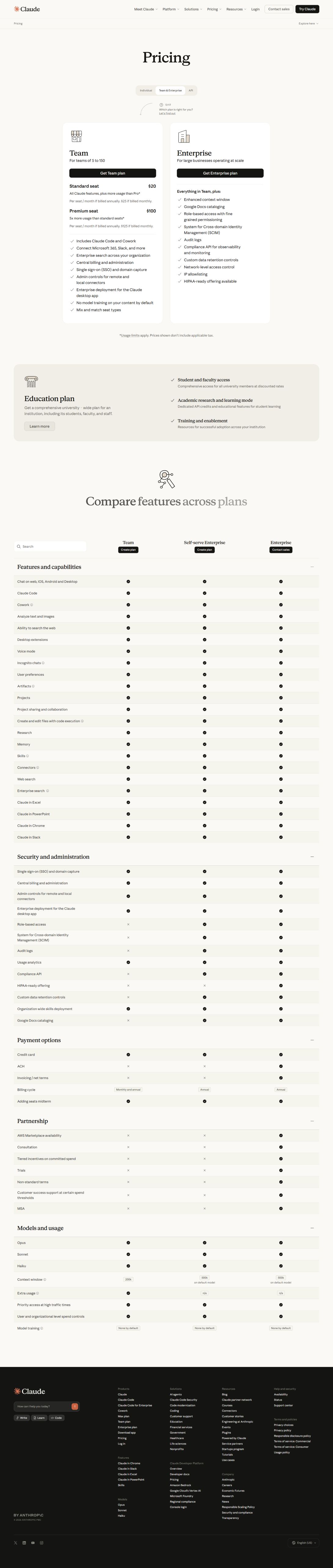
2. Team / Enterprise Plans (Team & Enterprise)For teams of more than 5 people, from small companies to large organizations. It starts at a minimum of 5 seats, and an annual commitment is usually cheaper.
- Team plan
Price:- Standard seat:$25/seat/month(annual billing; monthly is about $30)
- Premium seat:$100–$150/seat/month(depending on the specific configuration; includes advanced features such as Claude Code)
Minimum 5 seats.
Core features: - Includes all Pro capabilities + organization-level shared Projects and collaboration
- Central billing & management, SSO single sign-on, domain capture
- Admin controls (remote/local connectors), enterprise search (across organization content)
- Premium seats additionally include Claude Code, Cowork advanced collaboration, and early features
Suitable for: small/medium team collaboration and organizations that need shared knowledge bases and basic security controls.
- Enterprise plan
Price:Custom quote(contact sales; usually higher than Team, negotiated based on scale and customization needs)
Core features (greatly enhanced over Team):- Fine-grained role permissions (RBAC), SCIM identity management
- Audit logs, compliance API, custom data retention, HIPAA support
- Network-level deployment, Google Docs cataloging, IP controls
- Dedicated support, consulting services, volume discounts, MSA master agreement
- Stronger model availability (Opus and others, unlimited or high priority)
Suitable for: large enterprises, finance, healthcare, government and other organizations with strict requirements for security, compliance and auditing.
[Official Claude Team/Enterprise pricing screenshot]
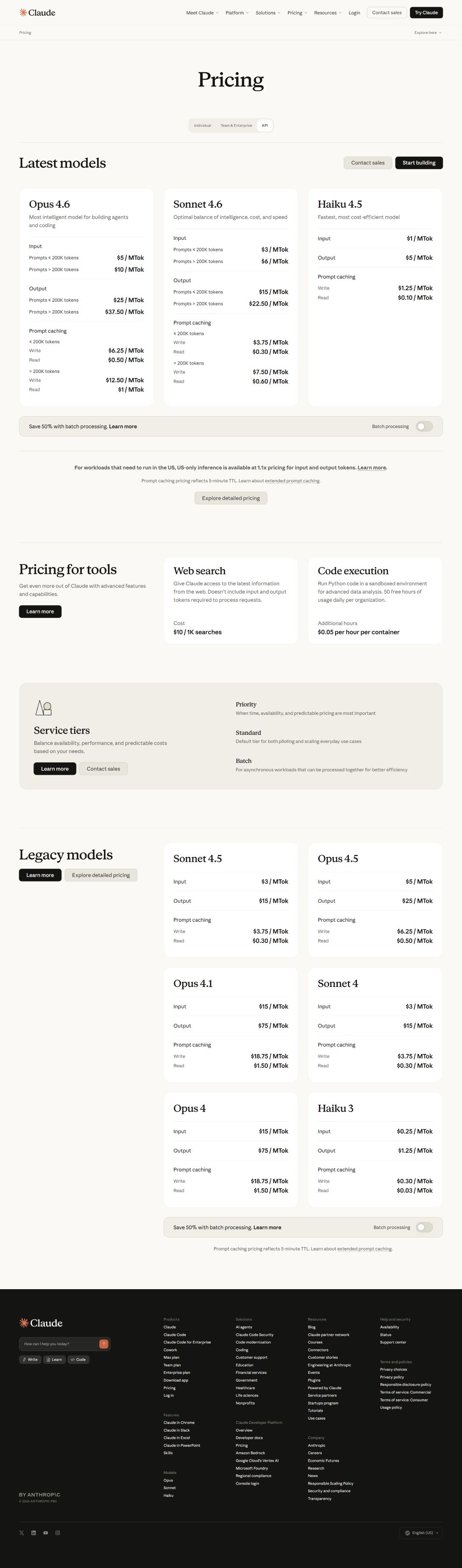
3. API / Developer Plan (Claude Developer Platform)Pay-as-you-go, suitable for building applications, automation and batch processing. No fixed monthly fee.
- Latest model pricing(2026 mainstream models, priced per million tokens, MTok):
- Claude Opus 4.6(most powerful): Input $5/MTok, Output $25/MTok (>200K prompts have higher-tier pricing)
- Claude Sonnet 4.6(best value): Input $3/MTok, Output $15/MTok
- Claude Haiku 4.5(fastest and cheapest): Input $1/MTok, Output $5/MTok
- Prompt Caching(prompt caching, greatly reduces cost): cache writes 1.25× input price, cache reads ≈0.1× input price, saving 50–90%.
- Batch processing: asynchronous batch tasks can save 50%.
- Additional tool fees: web search ≈$10 per thousand queries, code execution sandbox $0.05/hour, etc.
- Other: US-only inference +10% fee; the 1M token ultra-long context has extra charges during the beta stage.
[Official Claude API pricing screenshot]