Paul Rust / Nina Vasan
4 minutes
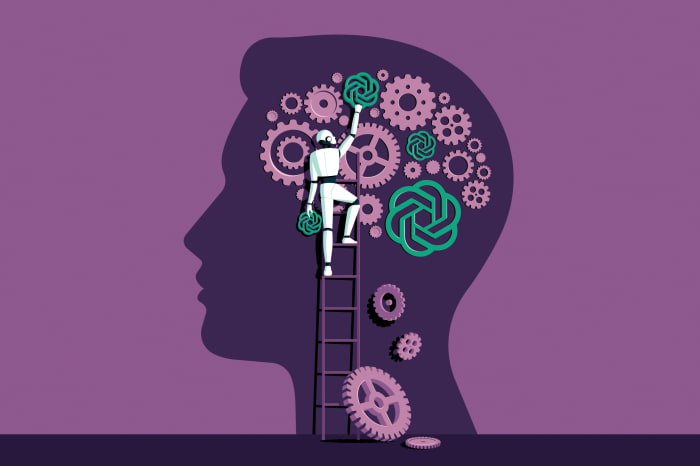
Image source: Beth Goody
ChatGPT is down, and suddenly you are at a complete loss. You stare blankly at the empty document. The report is due in two hours, but the mere thought of writing it yourself feels overwhelming. Where have all those analytical powers gone, the ones that once kicked in automatically? Whether it is breaking down the problem, organizing your thoughts, or finding just the right words, everything now seems incredibly hard. When did thinking become such a difficult thing?
As generative artificial intelligence (AI) reshapes the way we work, learn, and think, these moments of being unable to function without our technological crutch are becoming more and more common. In our lab, researchers have spent a decade treating patients, studying how technology shapes the human mind, and pushing to embed principles of mental health and well-being into AI and social media platforms. As generative AI enters the workplace and the campus at an unprecedented pace, we have observed a troubling phenomenon: AI is quietly eroding our cognitive abilities.
AI technology holds a powerful allure. As our colleague Darja Djordjevic, a psychiatrist at Harlem Hospital and Columbia University, puts it: “This is a machine that is always on call, endlessly enthusiastic, and seemingly capable of anything. It can create powerful feedback loops. You do not have to go through the discomfort of starting from zero; in just a few seconds you get the reward.”
No wonder our brains, which love to avoid difficulty, crave these shortcuts. Humans have always relied on technology to achieve cognitive offloading——using external tools to lighten the mental load. We take notes to aid memory, use calculators to do arithmetic, and rely on GPS to navigate.
Yet earlier technologies affected only specific abilities one at a time, whereas the impact of generative AI tools is all-encompassing. These tools have an extraordinarily broad range of applications and operate with a high degree of autonomy, so when we fire them up, our brains effectively go into a dormant state.
This is exactly where the risk arises. This convenience boosts short-term productivity while also accelerating long-term cognitive decline, affecting potentially more domains than any previous technology. Drawing on insights from psychology, patient care, aviation research, and behavioral science, we recommend cultivating four habits that promote more thoughtful interaction with ChatGPT——so that this interaction strengthens rather than weakens our cognitive abilities.
1. Draft first, prompt later
Our cognitive abilities are like muscles: use them or lose them. Offloading an entire task to AI can weaken our cognitive abilities such as problem-solving, creative thinking, and critical reasoning.
A recent study of nearly 1,000 students revealed this troubling phenomenon. Students who used ChatGPT to solve math problems outperformed their peers by 48% during the practice phase. But on a test where AI was not available, their scores were 17% lower than those of peers who had practiced without AI assistance. The short-term gains masked the long-term losses.
This pattern is not confined to the classroom. Research shows that in aviation, over-reliance on autopilot weakens pilots' manual flying skills. For this reason, the Federal Aviation Administration encourages pilots to fly manually on some legs of a flight in order to maintain proficiency.
For a long time, psychologists have emphasized the power of “mastery experiences”——conquering difficult problems through hard struggle——as the strongest predictor of self-efficacy (our internal belief in our own abilities). When ChatGPT clears the hurdles for us, mastery experiences simply cannot form; over time, this ability gradually fades, confidence steadily weakens, and dependence deepens by the day.
To keep your cognitive abilities sharp, try outlining your thoughts before you open the chat window. Think deeply about the problem and write down your ideas; just listing the key points is enough. Then let the model expand on them or polish them. This initial manual effort may feel like returning to the gym after months of neglecting exercise, but deliberate practice both maintains your skill level and protects your confidence.
2. Treat AI as a mentor
Have you ever noticed that after asking Perplexity or ChatGPT for an answer, you can stare at the screen and fluently explain the concept, but an hour later, your memory grows hazy and you stumble when trying to explain it to a colleague?
If we ask the AI directly for an answer, our level of engagement drops——and memory and understanding suffer accordingly. A preliminary study at the Massachusetts Institute of Technology (MIT) found that people who used ChatGPT to write essays were less able to recall their own essays. This result confirms the “Google effect,” whereby convenient information retrieval impairs the retention of internal memory; likewise, research shows that using GPS weakens spatial memory.
But the risks AI poses are not limited to isolated facts: we may lose our grasp of whole concepts and ideas, because an explanation is available with just a light click.
One possible solution is to turn the chatbot into a Socratic mentor. Instead of instructing the bot to “give me the answer,” try asking it to “guide me through breaking down the problem step by step, so that I can solve it on my own.” Ask the bot to explain in steps. Once the task is done, try closing the window and re-explaining the concept in your own words to test how well you have retained it.
A study of chemistry students showed that a modified ChatGPT model (one that does not directly provide solutions but only gives hints step by step) was more effective at boosting engagement and learning outcomes than the default model. With just a small adjustment—changing outcome-oriented prompts into process-oriented prompts—you can cultivate lasting understanding.
3. Pause and checklist
Do you often mechanically copy AI-generated results, only to be frustrated when a colleague points out obvious errors that somehow slipped right past you?
Heavy reliance on AI not only leads to skill atrophy but also impairs judgment and breeds bias. A study of 666 participants by the Swiss Business School and a survey of 319 knowledge workers conducted by Microsoft this year both found that heavy reliance on AI is positively correlated with a decline in critical thinking ability.
Relying on AI puts us in front of “automation bias,” leading us to blindly accept the machine's judgments and inherit its blind spots: in one behavioral science experiment, volunteers lost the chance to win a larger cash reward simply because the AI warned them not to trust their human partner, even though evidence already showed that cooperating with the human partner would pay off.
The risk goes far beyond a single decision-making error; if we cannot critically examine the AI's output, we may internalize the machine's inherent biases. In one experiment, participants viewed AI-generated images of “financial managers.” Although in real life fewer than 45% of financial managers in the United States are men (and even fewer are white men), 85% of the AI images portrayed financial managers as white men. Alarmingly, after viewing the AI images, participants also became more inclined to associate a white male identity with the role of financial manager.
To overcome this bias, you can use “cognitive forcing” tools (a method borrowed from medicine and aviation) to shift your way of thinking from intuition-driven fast processing to slow, deliberate analysis. Doctors use a “diagnostic pause” to double-check their reasoning; before takeoff, pilots run through a checklist in their minds. Try using the same approach: when the AI gives an answer, pause for a moment. Repeat the key points aloud or write them down. Then run through a checklist in your mind: Can the answer be verified? Are any angles being missed? Is there any bias? These kinds of metacognitive prompts can both catch errors and spark creativity and critical thinking.
Research shows that workers with stronger metacognitive abilities are more creative when using ChatGPT. In addition, a preliminary study suggests that if students are guided to ask themselves metacognitive questions when using generative AI for retrieval (for example, “To what extent does this answer match your expectations?” “Is there anything in the answer that you do not fully understand?”), they exhibit a higher level of critical thinking.
4. Try an AI-free period
The most direct way to maintain your thinking ability is to designate certain periods as “AI-free” zones. It could be one hour, one day, or even an entire project. To avoid dependence and keep your cognitive abilities sharp, doing it yourself is the most reliable way.
Generative AI is continuing its unstoppable rise, and it is forcing us to re-examine human capabilities themselves, both at the institutional level and the individual level.
In the corporate setting, AI has raised questions about talent and value creation. Companies that invest heavily in AI productivity tools may inadvertently erode their employees' long-term capabilities.
Educational institutions face an even thornier challenge: banning generative AI outright could leave students as digital illiterates in a world where AI is everywhere, but unrestricted use could weaken the very thinking abilities education is meant to cultivate. This challenge calls for building refined, evidence-based frameworks that guide students to keep exercising key skills while still making use of AI.
Of course, none of the above is an argument for shelving generative AI. Probably no one would be willing to replace Wikipedia with a paper encyclopedia, or trade Excel for an abacus. The challenge lies in cultivating a deliberate relationship between people and technology——harnessing technology's strengths without letting it hollow out our abilities.
Generative AI can be a partner, a muse, and an accelerator. But without deliberately set boundaries, this ever-present assistant no longer merely helps us write things; it becomes the true author, while humans are reduced to machines that only know how to click the “send” button.
The authors of this article: Paul Rust is a researcher at Brainstorm: The Stanford Lab for Mental Health Innovation and is pursuing a doctorate in theoretical medicine at the University Witten/Herdecke in Germany; Nina Vasan is the founder and director of the Brainstorm lab at Stanford University and the chief medical officer of the psychiatric clinic Silicon Valley Executive Psychiatry. They can be reached at the following email: [email protected].
Channel recommendation: The Economist Chinese Edition