Privacy should advance as fast as intelligence. OpenAI Private Intelligence gives businesses stronger controls over their data while using our most capable models.
We’re building these protections in close collaboration with some of our largest customers to help businesses apply
Today, we’re sharing a look at our expanded system for monitoring frontier models at OpenAI, which in September helped us catch a model’s attempt to access the live internet during training.
Since the Hugging Face incident—when models broke out of an internal cybersecurity
GPT-6.1 Terra is rolling out now and is available to all Plus, Pro, Enterprise, and Edu users in ChatGPT Work and Codex.
Developers can also access it through the OpenAI API as gpt-6.1-terra.
https://openai.com/index/introducing-gpt-6-1-terra/
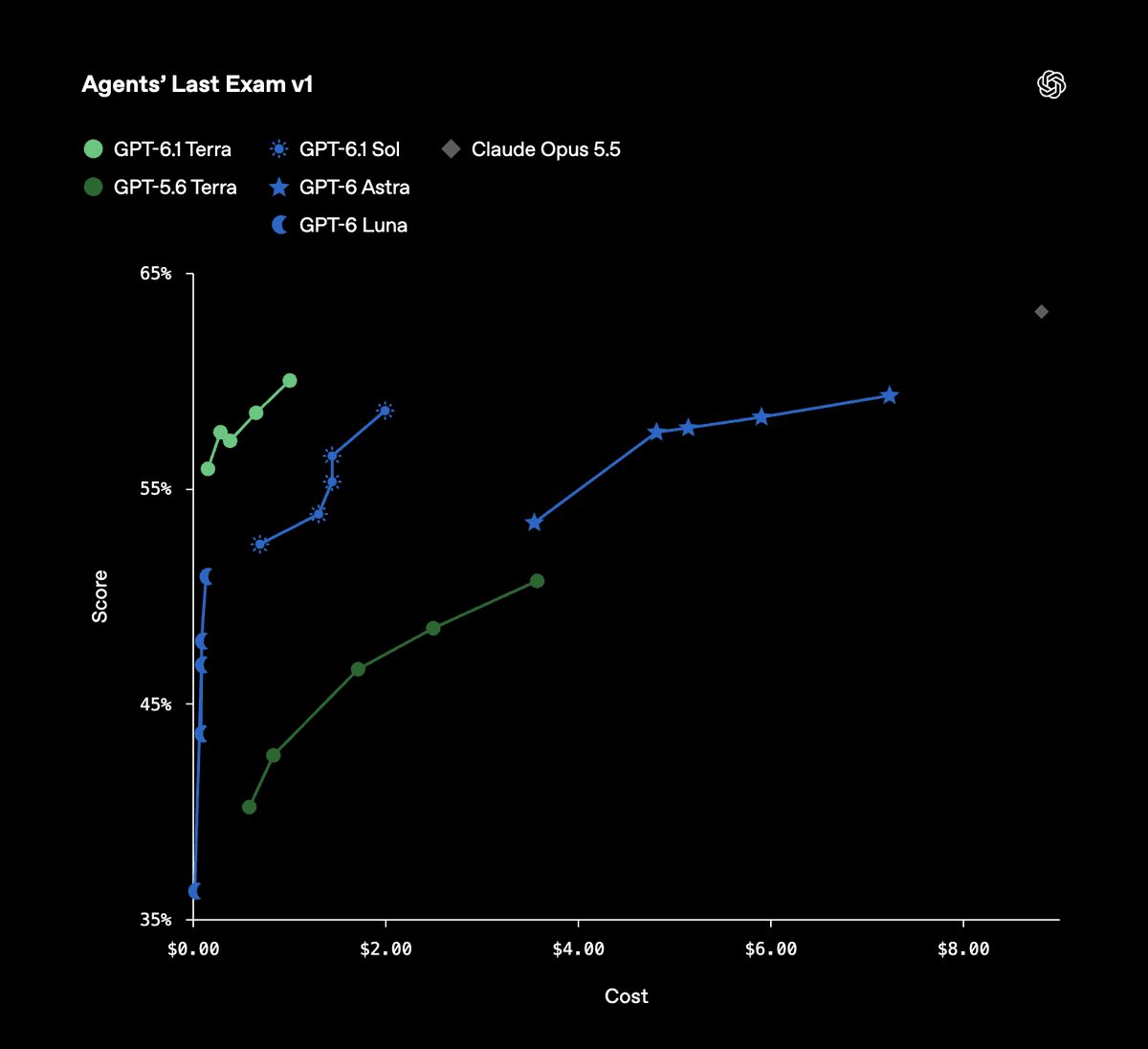
GPT-6.1 Terra substantially outperforms GPT-5.6 Terra on Agents’ Last Exam, a test of how well agents use software at work.
It even matches GPT-6 Astra at one-tenth the price per token and finishes tasks over 3× faster on average than both Astra and GPT-6.1 Sol.
GPT-6.1 Terra: delivering fast and capable computer use at a lower price.
GPT-6.1 Terra understands what’s on screen, takes action across apps, writes naturally, and is a more capable model for your whole workday with the efficiency to take on more of it.
GPT-6.1 Terra continues to advance the cost-intelligence frontier across our model families.
It’s a significant step up over GPT‑5.6 Terra, with 50% lower standard API prices.
In ChatGPT Work and Codex, your usage allowance goes further with GPT‑6.1 Terra than with GPT‑5.6
During this red-teaming exercise, we also found a vulnerability that allows for unauthenticated remote code execution in Brotli, a widely-deployed compression library included in many pieces of software such as Node.js, Bun, and Envoy.
The flaw could let an attacker run their
Over the past several months, we have substantially hardened the security of our research training environment. We’ve removed live internet access for all frontier models during training and built an offline world for them to use instead—a cached version of the web where they can
This summer, we invited METR and Redwood Research to pilot an embedded evaluation of our internal monitoring system, providing deep access to our infrastructure over three weeks.
Their findings helped strengthen safeguards as we expanded the system and will help shape future
OpenAI models are coming to Google Cloud.
We're bringing our frontier models and Codex agentic workflows to Google Cloud's Model Garden, so enterprises can use our technology where they already build.
https://openai.com/index/openai-models-google-cloud/
If you are wondering whether your website is affected, we have packaged a Codex skill to help check.
Point your Codex at this repo to guide you through it: https://github.com/openai/php2shell-checker
OpenAI models helped researchers—operating as part of our Patch the Planet initiative—discover critical security flaws in PHP, an open-source programming language used to run an estimated 70% of websites.
Over the past two months, we led a coalition of maintainers, researchers,
In the same mouse-brain dataset, GPT-Rosalind found a possible clue to why TSC2 mutations tend to cause more severe tuberous sclerosis than TSC1 mutations.
The two genes work together to regulate mTOR. Yet in one group of cerebellar neurons, disrupting TSC2 changed the
GPT-Rosalind surfaced a new lead for drug discovery: could restoring cholesterol transport protect neurons from degeneration?
DCTN1 is a gene linked to Perry syndrome, a rare neurodegenerative disorder. In mouse-brain data, disrupting it increased expression of genes involved in
We’ve acquired Orchestra Bio, a platform that helps biopharma teams coordinate the complex process of drug development.
Together, we’ll build on Rosalind, our AI models and tools for life sciences research, to streamline those operations and help new treatments reach patients
Our latest model advances bring stronger capabilities for building and migrating software in low-resource programming languages such as COBOL, Fortran, and Visual Basic.
These languages power software that banks, governments, and businesses depend on. Progress here means